
Growing a Legacy Brand Alongside the Business
Merrill Engineers and Land Surveyors did not have a reputation problem.
Founded in 1979, the firm had earned decades of recognition across the South Shore of Massachusetts. Its name meant something to clients, employees, and the communities it served.
But in 2013, Merrill was approaching a significant transition. Founder Bob Merrill was preparing to retire, and Josh Bows was positioning himself to purchase and lead the company.
The marketing had not kept pace with the strength of the business. The website showed its age. Print and digital materials were limited and inconsistent. The identity reflected the company’s history, but not the younger, more modern engineering and land surveying firm Josh believed Merrill could become.
This was not an opportunity to erase the past.
It was an opportunity to build on it.
Deliverables
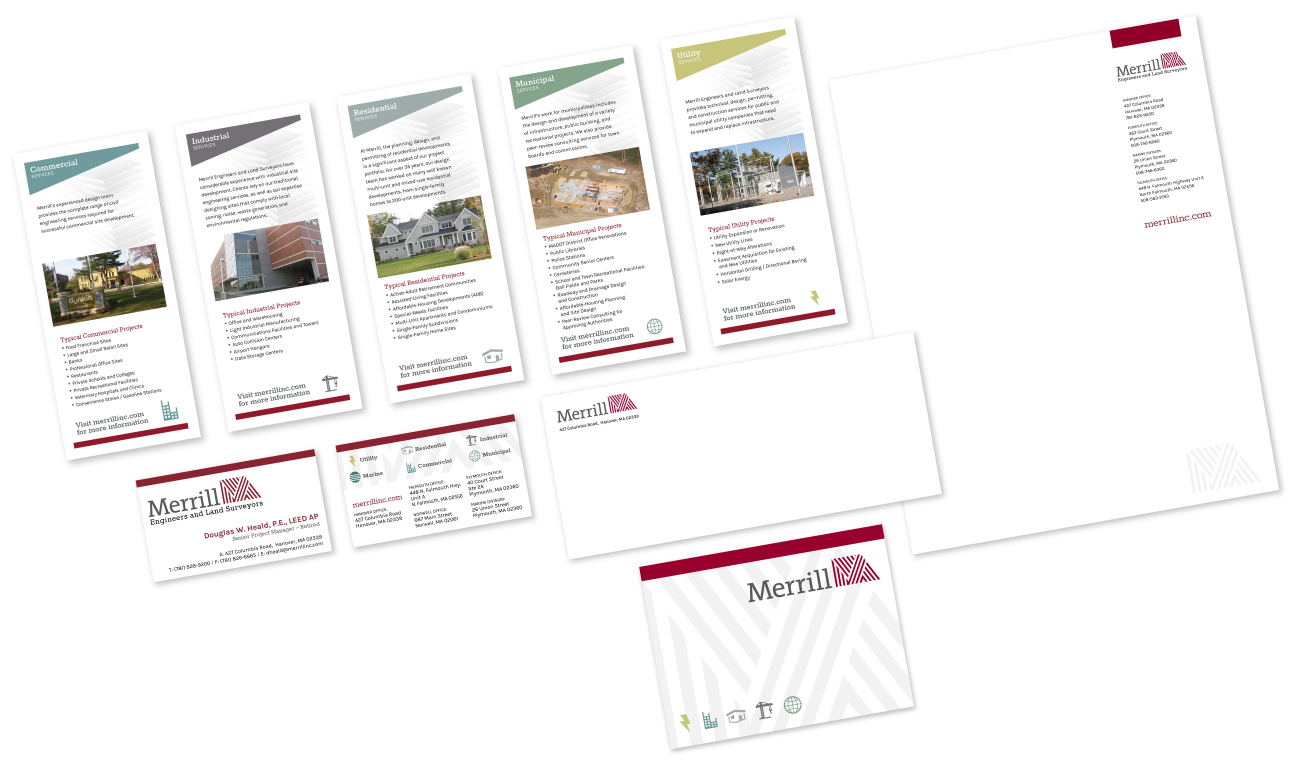
The original engagement included a refined logo and visual identity, a WordPress website, stationery, business cards, brochures, advertisements, email signatures, Mailchimp templates, RFP templates, marketing collateral, and signage.
As Merrill evolved, the work expanded with it. New offices and services required updated signs, website sections, photography, content, case studies, employee profiles, recruiting materials, and ongoing marketing support.
Results
More than a decade later, Merrill’s identity remains recognizable while the company around it has continued to change.
The firm has expanded beyond its original Hanover office, added capabilities and specialized expertise, developed its marine practice, embraced redevelopment as a defining strength, and invested more intentionally in recruiting and company culture.
The website has evolved through two major upgrades without requiring Merrill to discard everything and begin again. What started as project-based support has become an ongoing marketing partnership focused on clarity, consistency, awareness, and growth.
Scope of Work:
Rebranding and visual identity
Website strategy, design, and development
Content strategy and copywriting
Signage and environmental graphics
Proposals and RFP templates
Marketing collateral and advertising
Email marketing support
Case studies and employee profiles
Recruiting and employer marketing
Search and AI visibility strategy
Ongoing creative direction and production
A leadership transition gave Merrill a reason to reconsider its identity. It did not give the company a reason to throw away everything people already recognized.
The Company Was Changing, but the Name Didn't Need to
A change in ownership often creates pressure to put a new name on the door.
Josh saw it differently. Rather than treat the transition as permission to replace everything, he started by asking what had already earned the right to remain.
That same thinking applied to the logo.
A local designer created its distinctive M in the 1970s. It was memorable, recognizable within the company’s market, and meaningful to Bob Merrill.
The problem wasn’t that the identity lacked anything worth preserving. The typography, colors, and surrounding materials simply made a strong mark feel unnecessarily dated.
Merrill needed to distinguish between history that had earned its place and design decisions that were showing their age.
That distinction shaped the entire rebrand.
“I didn’t change it to Bows because it wasn’t something I created. Keeping the name honored Bob Merrill and the reputation he had built. I underestimated how much that would mean to him—and the existing brand recognition made the ownership transition seamless to the outside world.”
— Josh Bows, President, Merrill Engineers and Land Surveyors
Rebranding Merrill didn’t require starting over. It required knowing exactly what to keep—and having the confidence to change the rest.
Preserve the Icon and Modernize the System
The recognizable icon remained at the center of Merrill’s identity.
We made one small adjustment to remove a detail that no longer helped the mark. Updated typography created a clearer relationship between the icon and the company name. A new visual system introduced strong angles, graphic elements, and a dark red and purple palette that felt modern without looking like every other engineering firm.
The color combination was an early test of how far Merrill was willing to go.
It was professional, but not predictable. It made the company more recognizable and demonstrated that Josh was willing to trust the people he had hired rather than retreat toward the safest possible answer.
Merrill did not need to look trendy. It needed to look confident, capable, and comfortable standing apart.
A successful identity could not remain an attractive logo presented in a meeting. It needed to improve the materials Merrill’s employees and clients used every day.

Give the Brand Practical Work To Do
Engineering firms depend on marketing materials that are rarely featured in glamorous branding presentations.
Proposals need to be assembled. RFP responses need to look organized and credible. Employees need business cards and email signatures. Offices need signs. Clients need brochures that explain complicated services clearly.
The original engagement created a practical marketing toolbox spanning stationery, business cards, RFP templates, brochures, advertisements, email communications, signage, and a new WordPress website.
Every piece shared the same new visual language, giving Merrill a more consistent presence whether someone encountered the company through a proposal, an advertisement, a roadside sign, or its website.
The system was built for actual use—not just launch day.
It would not take long for Merrill to test how well that system could travel.
The new toolbox was built for the Merrill of 2013. Its first real test came when the company began expanding beyond Hanover.
Making Growth Recognizable
Merrill began expanding beyond its Hanover headquarters in 2014, establishing a presence in Plymouth and on Cape Cod. New signs for the satellite locations followed in 2016.
Signage became one of the identity’s most visible applications.
Bold colors and strong diagonal forms helped each office stand out while remaining immediately recognizable as Merrill. The goal was not merely to display the company name. It was to create the kind of sign someone remembers after driving past it.
As the company continued to grow, its physical presence evolved again. Updated signage was created for the Hanover office and new Plymouth headquarters in 2024, carrying the same identity forward with more than a decade of additional experience behind it.
The locations were not the only things changing.
New employees brought specialized knowledge, relationships, and capabilities. Marine work developed into a more visible area of practice. Experience from engineering, surveying, local government, permitting, photography, drone work, and other disciplines gave Merrill more stories to tell and more ways to help clients.
The identity did not need to be replaced every time the company found another opportunity.
It needed enough structure to remain familiar and enough flexibility to make room for what came next.


Signage proved that the identity could stretch across new locations without losing recognition. The website presented a different challenge: it had to evolve with both the company and the technology behind it.
The Website Had To Keep Moving
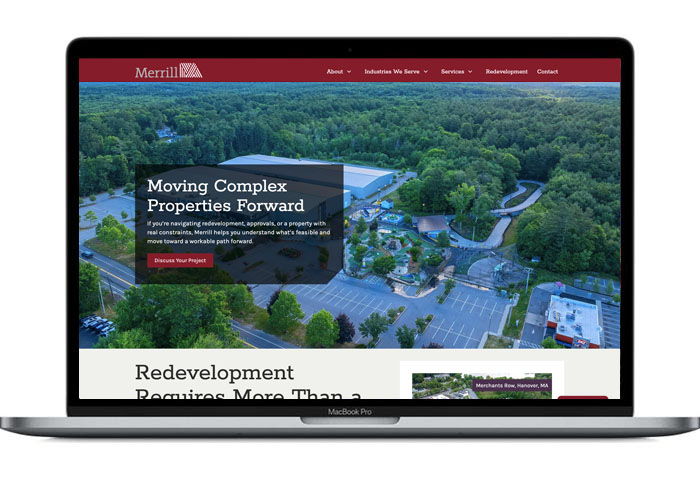
Merrill’s first redesigned website launched in 2013, when responsive web design was still developing and many of today’s mobile conventions had not yet become established.
The largest investment was content.
The site needed to help someone unfamiliar with Merrill understand what the company did, who it worked with, and why its services mattered. It also needed to look and feel connected to every other part of the new identity.
By 2021, both Merrill and the web had changed.
Mobile behavior was better understood. Accessibility deserved greater attention. Design and development tools made it possible to carry the brand’s angles and visual language more naturally into the digital experience. Merrill also had additional services, locations, people, and expertise to represent.
A substantial Beaver Builder rebuild improved the site’s usability, responsive behavior, accessibility, and flexibility while giving marine services greater visibility.
The objective was not to discard a working website for the sake of appearing new. It was to recognize when the experience no longer represented the company—or met reasonable expectations for how people used the web.
Another major component upgrade followed in 2026. Newer tools allowed the site to use Merrill’s signature angles more effectively and introduced reusable systems for case studies, employee profiles, recruiting content, and emerging redevelopment messaging.
Each generation built on the one before it.

Legacy Site
We inherited a non-responsive site which didn't represent where Merrill was in 2013.
2013
Beyond new messaging and positioning, we rebuilt with WordPress with a focus on responsive design, new branding, optimized service and industry landing pages.


2021
Site was updated with newer theme and Beaver Builder software. New drone photography was added throughout site. Marine industry added to site. Database driven team page added.
2026
CSS Grid/Box model, component, and mobile enhancements. Redevelopment landing page. Case studies. Employee spotlights and team page enhancements.
Each website update addressed a visible need. Regular conversations about search revealed a larger opportunity: marketing could become an ongoing practice rather than a series of isolated projects.

Marketing Became an Ongoing Practice
In 2021, Merrill and 3thought began meeting regularly to review search performance and identify opportunities for improvement.
That recurring communication mattered as much as any individual report.
The process established a rhythm that felt natural for an engineering firm: develop a baseline, identify a problem or opportunity, try something, measure what can be measured, and improve the next iteration.
Over time, the conversations became broader than rankings and website traffic.
Search behavior was changing. AI tools were influencing how people discovered and evaluated companies. Traditional SEO data remained useful, but it no longer described the entire journey.
Merrill’s goals were changing, too.
The company wanted to attract strong employees, show more of the expertise already inside the firm, communicate its growing redevelopment experience, and give prospective clients better evidence than a list of completed projects.
Project listings began evolving into case studies that explained the challenge, Merrill’s role, and why the work mattered. Employee biographies became a more structured profile system. Interviews created opportunities for engineers and surveyors to explain their work in language other people could understand.
The marketing began doing more than documenting services.
It started making Merrill’s people, thinking, and culture more visible.
As those conversations expanded beyond rankings and traffic, the focus shifted toward Merrill’s strongest source of credibility: the people doing the work.
Building the Brand Around Its People
Josh wants Merrill to be recognized as an excellent place to work—and he wants the people doing excellent work to receive the attention.
That changes the role of marketing.
Recruiting cannot depend entirely on an open-position page. Prospective employees need to see the kinds of projects they could work on, the people they would work beside, and the opportunities they could have to develop specialized expertise.
Merrill already has employees capable of contributing to that story.
Jason’s photography, video, and drone work can document projects and provide a perspective an outside marketing team could not manufacture. Heather can support social media and email communication. Engineers, surveyors, permit specialists, and project managers hold the subject-matter knowledge behind the company’s reputation.
3thought’s role is not to take every responsibility away from them.
It is to provide direction, create repeatable systems, train and support internal contributors, and handle the work that requires dedicated marketing, writing, design, production, or digital experience.
That approach gives Merrill more marketing capacity without requiring every employee with a useful skill to become a full-time marketer.
Helping Merrill’s people tell the company’s story changed the nature of the relationship. What began as a series of individual assignments was becoming a shared marketing plan.
A Brand Built for What Comes Next
By late 2025, the relationship was ready to become more deliberate. Instead of waiting for the next request, the two teams began talking directly about what Merrill wanted to grow, where marketing could create clarity, and which systems deserved consistent attention.
That conversation led to an ongoing engagement in 2026. Monthly and quarterly planning now connects long-term priorities with everyday execution—from redevelopment positioning, recruiting, and website strategy to email support, signage, banners, and whatever needs to be solved next.
Sometimes Merrill needs strategic direction.
Sometimes it needs a banner by Friday.
The value comes from having a partner who understands the company well enough to recognize the difference—and can be useful in either situation.
It would be self-serving to attribute Merrill’s growth to the original rebrand. That would not be accurate.
The company grew because of strong leadership, talented employees, an established reputation, new capabilities, and a willingness to recognize opportunities. Our role with the brand was to keep pace.
It gave new offices a recognizable presence, made room for new services, equipped employees with better tools, and gave prospective clients and future hires clearer evidence of the company Merrill had become.
Thirteen years after the original project, the identity remains recognizable. The company around it is larger, more capable, and more ambitious. The relationship has evolved, too—from a rebranding engagement into an ongoing partnership invested in what Merrill and its people want to accomplish next.
For an established regional organization, that may be the real value of a rebrand. It preserves the recognition you have earned while creating room for what comes next.
"When I look at the volume and range of projects we’ve completed together, it’s honestly kind of astonishing. That only happens when there’s real trust and both sides are looking out for each other’s best interests. Josh sets that tone. Maybe it’s the engineer in him, but it has always been a good fit—and Merrill’s projects are ones we genuinely look forward to."
— Matt Ulvila, Vice President, 3thought