Rebuilding a Complex Nonprofit Website Around Its Mission
Case Study
Web Design & Development
Content Strategy
A four-month redesign, rebuild, and content cleanup that turned more than 900 pages and posts into a clearer, more useful system for visitors, donors, volunteers, and staff.
The National Marine Life Center is a regional nonprofit with an ambitious mission. From its facility in Buzzards Bay, Massachusetts, NMLC rehabilitates endangered sea turtles and protected seals, advances marine science, and helps people understand the challenges facing local marine life.
The work mattered.
The website made it unnecessarily difficult to understand.
Visitors were not always sure whether NMLC was an aquarium, an animal hospital, or a place they could visit. Important information was scattered across years of pages, blog posts, social media updates, and disconnected systems. Broken links, inconsistent messaging, and a difficult mobile experience made a serious organization appear less capable than it was.
NMLC did not simply need a better-looking website. It needed a digital system built around the organization it was becoming.
Scope of Work:
Website strategy and information architecture
UX and visual design
Content strategy and copywriting
Mobile and accessibility improvements
Hosting, account, and platform organization
Reusable publishing systems
Before anything visible could change, NMLC had to understand—and regain control of—what was happening behind the scenes.
First, Find the Keys
The project began in March 2026 after a conversation with Jay Munsey, then Chair of NMLC’s Board of Directors.
What started as a discussion about sponsorship and community support exposed a much larger need. Jay understood that awareness, credibility, and fundraising depended partly on the organization’s website. To inventory the content and plan the rebuild, 3thought needed administrator access to see what was actually there.
That first key opened the door to everything else: hosting, DNS, connected services, account ownership, and years of undocumented decisions.
Recovering access required contacting former leadership, restoring old email accounts, resetting passwords, and working directly with the previous webmaster.
Once the system was visible, NMLC could make informed decisions about what to preserve, replace, or reorganize. Professional hosting was established, DNS returned to the organization’s control, and 3thought was added as a partner with access—not another gatekeeper holding the keys.
It was not the most visible part of the finished website.
It was the work that made everything else possible.
“You’d be surprised how many organizations don’t know who controls their website, hosting, or domain. It happens after years of staff changes, volunteers, and vendors. We’ve done this enough times to know where to start looking, which questions to ask, and how to get the keys back into the client’s hands.”
— Matt, 3thought
Over 900 Pieces of Content—and No Clear Story

The initial inventory included 45 pages, 887 blog posts, and 30 categories.
Some information was outdated. Some appeared in multiple places. Many pages promoted expired events, discontinued programs, or material that no longer reflected how the organization operated. More than 30 loosely managed blog categories and thousands of tags made even useful content difficult to find.
The challenge was not simply deciding what to remove.
Buried within the archive were interesting scientific articles, educational material, institutional history, and stories that still deserved an audience. Some pieces had reached the end of their useful life. Others needed consolidation. A select few only needed polish and a better place to live.
The sitemap became the plan.
Like packing for a move, content was sorted by where it belonged. Related information was brought together. Valuable URLs were preserved, and redirects were created where pages changed.
NMLC handled much of the large-scale pruning. 3thought reorganized the remaining structure, reduced more than 30 blog categories to a focused set of 10, and surfaced useful legacy content within the new Science and Education sections.
Eight separate giving pages became one clearer giving story.
Stranded-animal information was reorganized around the questions people actually have: Where are you? What animal did you find? Who should you call?
The objective was not to erase NMLC’s history or make the website feel smaller. It was to preserve what mattered and make the important content easier to find.
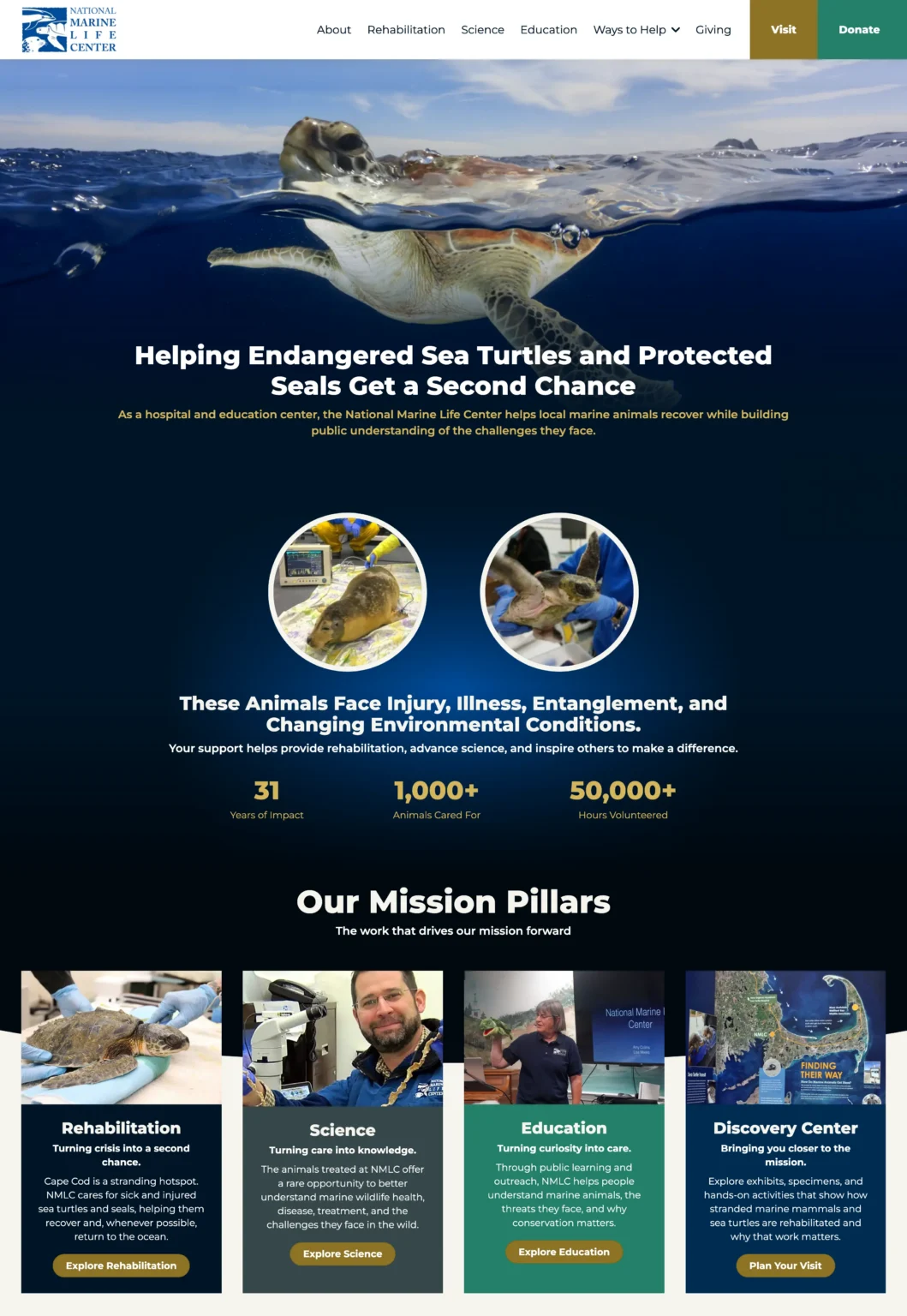
The visual story needed to shift toward animals receiving care, medical teams at work, and the moments when healthy animals could return to the ocean.
Making the Mission Clear
NMLC’s core areas—rehabilitation, science, education, and the Discovery Center—already existed.
What they lacked was a clear relationship to one another.
Interviews and working sessions helped define the role each area plays:
- Rehabilitation turns crisis into a second chance.
- Science turns care into knowledge.
- Education turns curiosity into care.
- The Discovery Center brings people closer to the mission.
Together, those ideas created a framework for the website and a clearer explanation of what NMLC does, why the work matters, and how someone can support it.
The messaging also had to set honest expectations.
NMLC is not an aquarium. It does not keep animals on display for entertainment. The Discovery Center is a place to learn about marine animal rehabilitation through exhibits, specimens, and hands-on activities. During certain periods, visitors may see animals receiving treatment—but that is never promised.
That distinction could not depend on visitors reading every word. Photography had to carry the story, too.
There were plenty of appealing photographs of seals and sea turtles. But relying on cute animal photos would have reinforced the wrong impression. The visual story needed to shift toward animals receiving care, medical teams at work, and the moments when healthy animals could return to the ocean.
The images still carried the emotional power of the mission, but now that emotion had the right context.
The clearest version of NMLC’s story wasn’t sitting on the old website. It lived with the people doing the work.
The next challenge was drawing out that knowledge and shaping it for everyone else.
Every Page Started With Three Questions
Organizations serving multiple audiences cannot assume everyone arrives with the same goal.
Content strategy and message refinement were part of the engagement. Every page began with a content worksheet informed by existing material and conversations with NMLC’s board and staff.
NMLC brought the subject-matter expertise. 3thought brought an outside perspective and three recurring questions: What is this person trying to do? What do they need to know? What is their logical next step?
The answers determined what belonged on the page, how it should be organized, and how that experience could support NMLC’s broader mission.
A parent planning a rainy-day activity on Cape Cod wants to know when the Discovery Center is open, where to park, how much it costs, how long a visit takes, and whether children will enjoy it.
Someone walking on the beach who finds a stranded animal needs the right phone number immediately.
A prospective volunteer needs to understand available roles, expectations, and whether applications are currently open.
A donor needs to know what their support makes possible and the different ways they can help.
The content workbook helped answer what visitors needed to know, but it also exposed a gap in how NMLC documented and shared the impact of its rehabilitation work.
Giving Patient Stories a Permanent Home
A seal named Salty was featured prominently on the old website, but Salty's story functioned as a one-off rather than the beginning of a useful patient archive.
More patient stories existed. They were just buried on Facebook.
Someone visiting NMLC.org could learn that the organization rehabilitates marine animals without meeting the individual patients, seeing the care they received, or understanding the outcomes behind that work.

Recovering every long-forgotten Facebook post was not practical. Instead, 3thought recovered four patient stories and created a website-first publishing system for future ones.
Those initial records tell the stories of Banana Split, Dexter, Moon, and Sea Turtle #44—what brought them to NMLC, the care they received, and, when possible, their return to the ocean.
The work was already happening.
Now there is proof.
Each patient story has a dedicated, indexable home on NMLC.org. New stories can be published consistently without designing another page from scratch. Social media can still help distribute them, but it no longer has to be the only place they live.
Over time, the Patient Story Archive should become a growing record of NMLC’s impact—discoverable by visitors, visible to search engines, and owned by the organization.
“Nothing you say about your organization matters if people can’t find it. Good UX removes the friction between a visitor’s question and the answer.” — Matt, 3thought
A Better Experience on Smaller Screens
Mobile design was treated as part of the system—not as a desktop layout squeezed onto a phone.
The primary navigation was rebuilt as a more intentional flyout experience. Selective carousels let visitors browse related content without turning every page into an endless vertical scroll. Flexible layouts help images, calls to action, patient stories, and informational content remain useful across screen sizes.
Accessibility informed decisions throughout the rebuild. The site received a dedicated pass focused on AA-appropriate choices, including readability, hierarchy, contrast, navigation, and interactions.
This was not a formal accessibility certification. It was a deliberate effort to make the website easier for more people to read, navigate, and use.

The visitor experience was not the only one that mattered. Someone at NMLC would inherit the website after launch.
Building for the People Who Take Over
One question shapes the scope of nearly every website project: Who will be responsible for this after launch?
A website can be technically editable without being realistically manageable. Something that takes an experienced developer two minutes may take a staff member 30 frustrating minutes—and pull them away from the job they were actually hired to do.
Early in the project, 3thought identified what would need ongoing attention, how frequently it might change, and who should reasonably be responsible for it. Hours, patient stories, volunteer opportunities, events, and job openings needed to be approachable. Structural changes and technical maintenance did not need to become another staff responsibility.
Those boundaries shaped the systems we created.
WordPress, reusable Beaver Builder components, and custom content types were chosen not simply to manage data, but to create guardrails. Common updates follow consistent patterns. Staff can change the information without redesigning the page, rebuilding a layout, or accidentally disrupting the rest of the site.
Being comfortable with technology does not make someone a website professional. The youngest “digital native” on staff should not automatically become the organization’s accidental webmaster.
The web is fragile. A flexible system should make routine work easy, structural work difficult to damage, and the line between the two clear.
That is what makes a website manageable after the people who built it step away.
The new website's systems are built around what NMLC’s staff would reasonably need to do after launch. Routine updates had to be easy; maintaining the machinery behind those systems was should not become another part of their job.
The long-term value of the systems we built will reveal itself over time. Other changes were apparent the moment the new site launched.
A Visible Before and After
Long-term changes in traffic, donations, and engagement will need more time before they can be evaluated responsibly.
Other results were immediate.

Broken links and disconnected services were repaired. Mobile visitors could navigate the site without fighting it. Important rehabilitation, science, education, visiting, volunteering, and giving information became easier to find. Patient stories that once disappeared into social media gained a permanent home.
Most importantly, the website now more accurately reflects the organization behind it: a small, committed team doing serious work for marine animals and the people who care about them.
The new website does not manufacture NMLC’s impact.
It finally gives that impact the structure, clarity, and visibility it deserves.
We’re selective about website projects. It's taken a long to time to be comfortable with the idea that we're not the right fit for everyone. If your organization has a story people should care about, complicated systems to untangle, and a budget for something beyond brochureware, 3thought may be a good fit to help you.